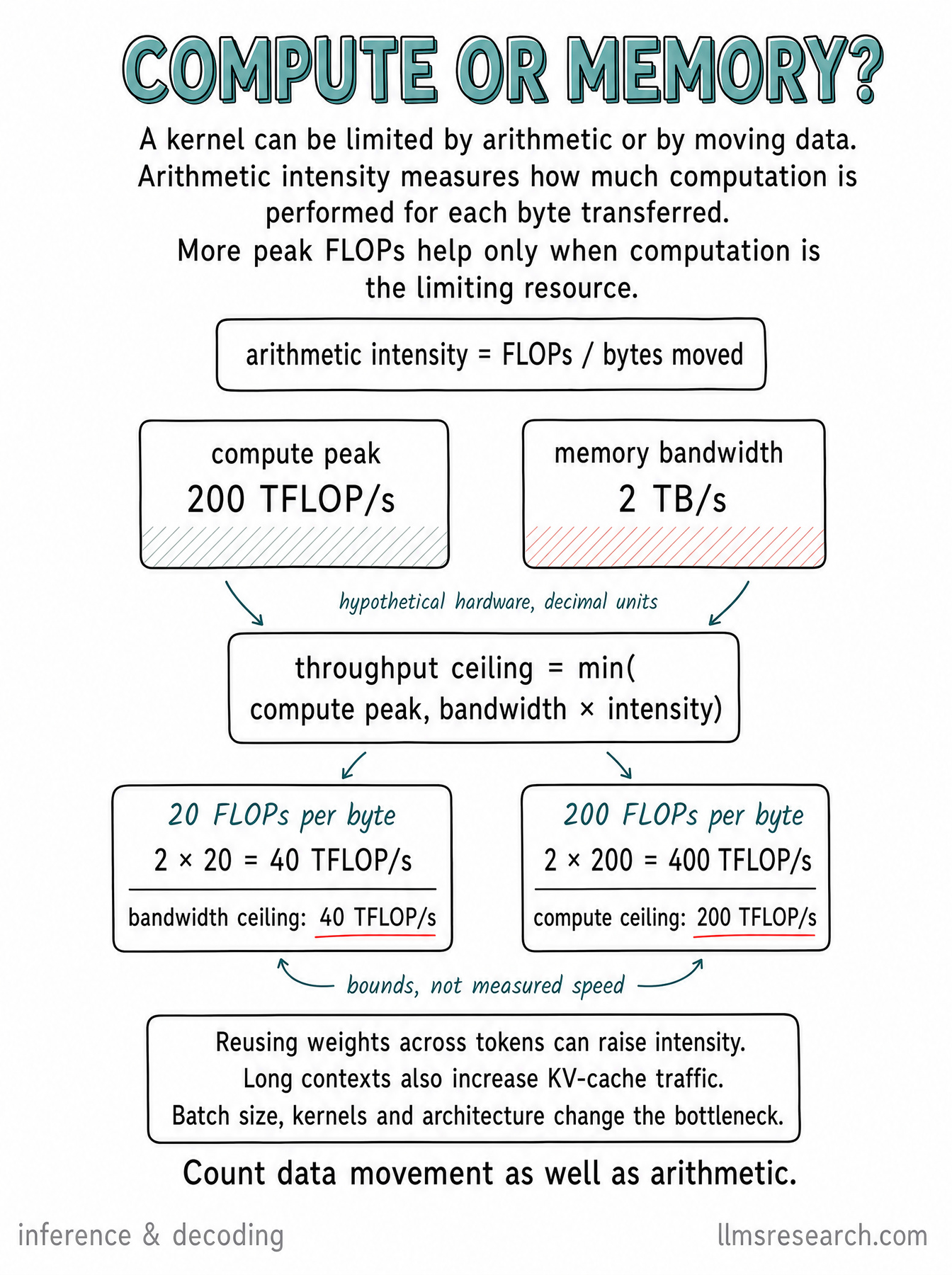
Compute-bound inference is limited mainly by arithmetic throughput. Memory-bound inference is limited mainly by moving data from memory. Arithmetic intensity, measured as operations per byte moved, helps identify which limit a workload is approaching.
Read the roofline bound
For a simplified device with 200 TFLOP/s of compute and 2 TB/s of memory bandwidth, the throughput bound is the smaller of:
200 TFLOP/s
2 TB/s × arithmetic intensity
At 20 FLOP per byte, bandwidth limits the bound to 40 TFLOP/s. At 200 FLOP per byte, the bandwidth term is 400 TFLOP/s, so compute limits it to 200 TFLOP/s. The example uses decimal units and illustrative hardware figures.
Why batching can change the bottleneck
Reusing loaded weights across more tokens can raise arithmetic intensity. This helps explain why prompt processing and single-request token generation can behave differently on the same accelerator. Context length, batch size and kernel choice affect the balance.
The roofline is an upper bound, not a latency prediction. Communication, scheduling, cache behavior and imperfect kernel utilization can keep real throughput below both limits. Measure the actual stage before choosing an optimization.