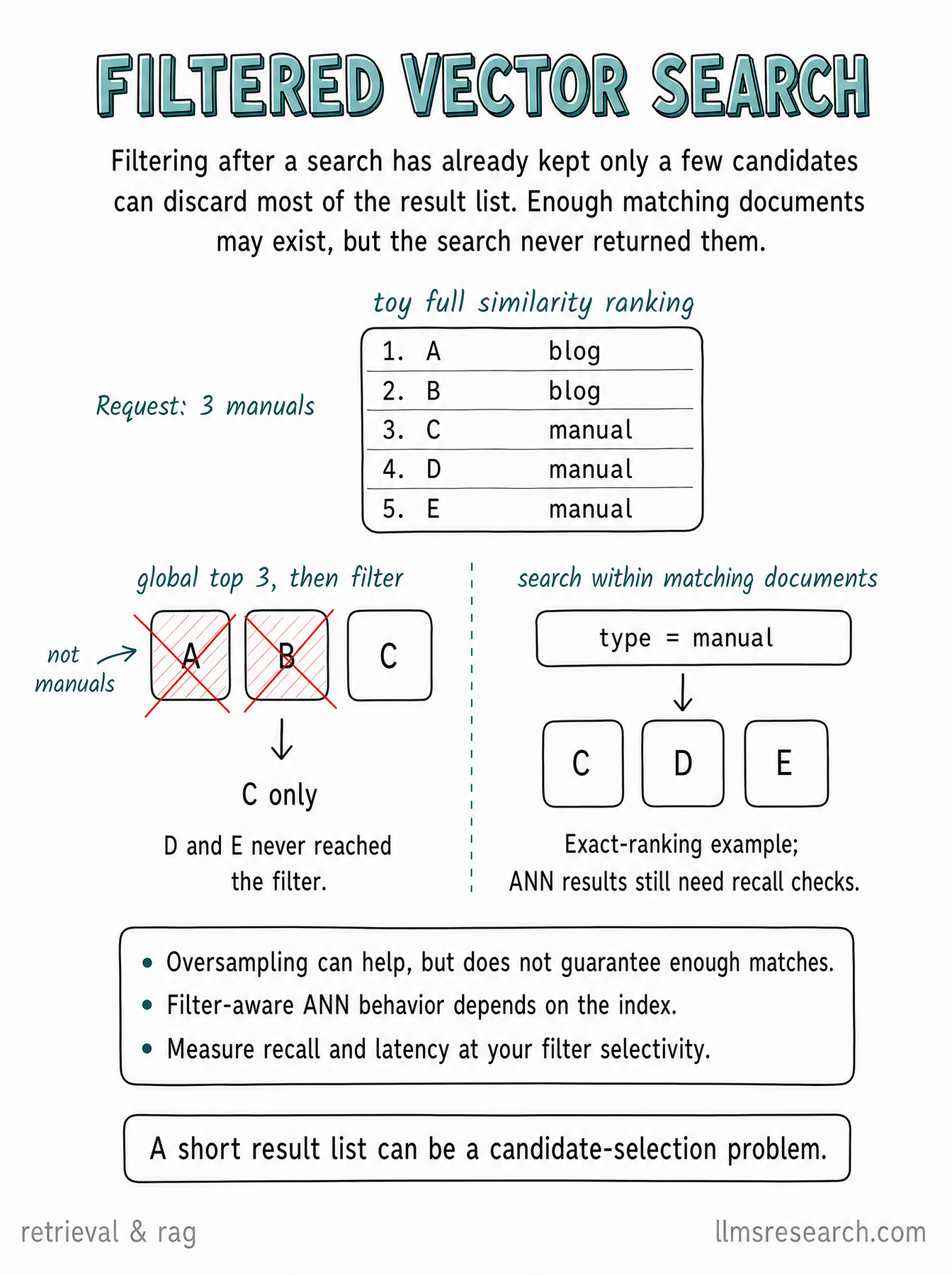
Filtered vector search combines similarity ranking with a condition such as document type, tenant or language. Where the filter is applied can change which results remain available.
Why filtering a short list can lose results
Suppose the global nearest-neighbor order is A, B, C, D, E. A and B are blog posts; C, D and E are manuals. If the system retrieves the global top three and then keeps manuals, only C survives. Searching for the top three among eligible manuals instead returns C, D and E in this exact toy ranking.
The difference is the candidate set. Post-filtering cannot recover D and E after the earlier cutoff has already removed them. Retrieving more candidates can help, but an adequate candidate count depends on filter selectivity and the data.
Approximate indexes add another variable
Real approximate nearest-neighbor systems implement filtering in different ways. A filter during traversal, a filtered candidate set and a filter after retrieval are not interchangeable algorithms. Measure recall and latency with realistic filters, including restrictive ones.
For access control, enforce eligibility in trusted application or retrieval logic before any text reaches the model. A ranking strategy is not by itself proof that permissions are enforced.