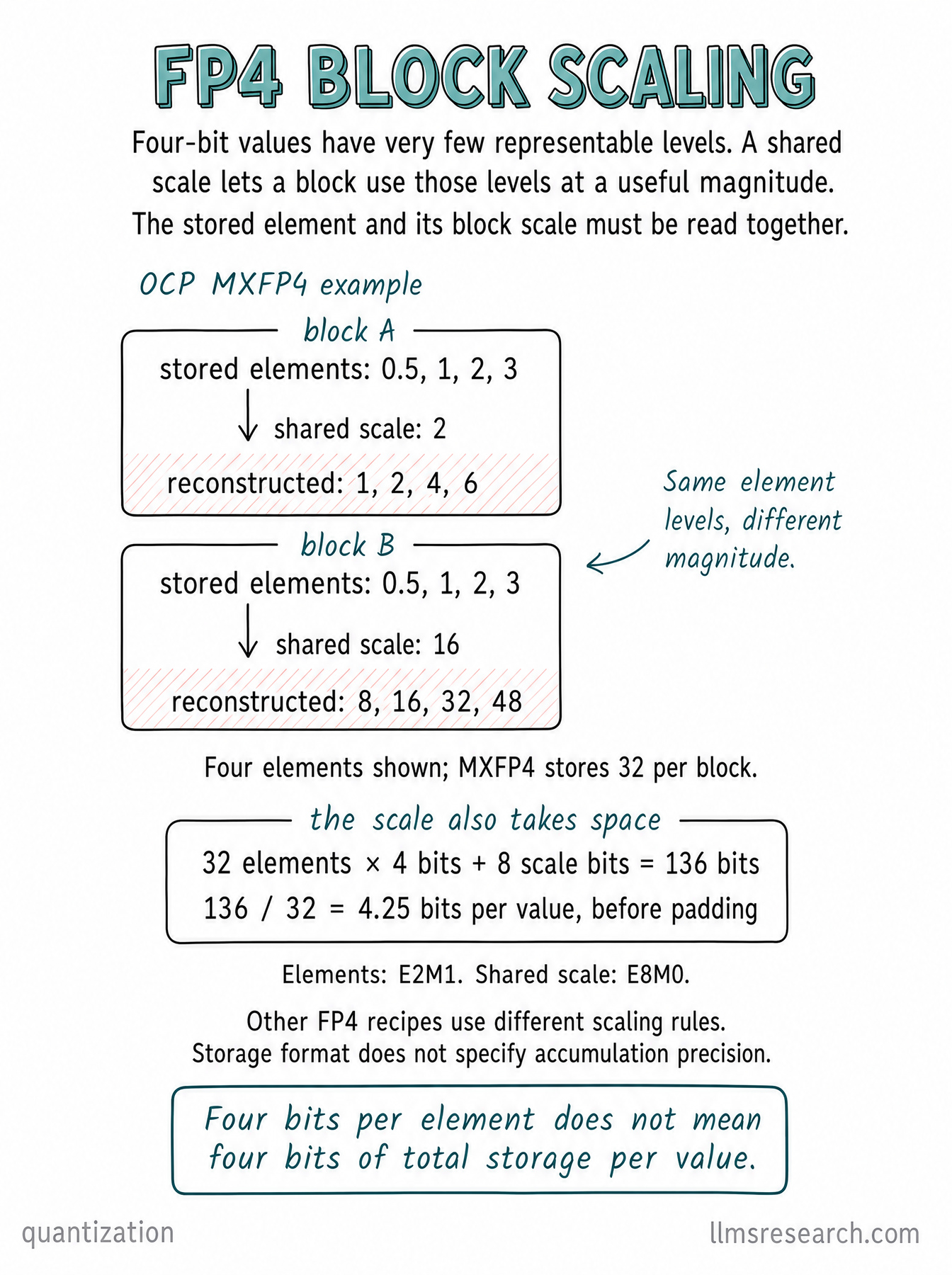
Block scaling stores several low-precision values together with a shared scale. The card uses the OCP MXFP4 format specifically: a block of 32 E2M1 FP4 values and one E8M0 scale. Other formats called FP4 can use different layouts.
The shared scale changes the represented values
Four example stored values are 0.5, 1, 2 and 3. With a scale of 2, they represent 1, 2, 4 and 6. With a scale of 16, the same stored values represent 8, 16, 32 and 48. Each value still has a coarse four-bit representation; the scale changes the block’s magnitude range.
Count the scale bits too
Thirty-two four-bit values require 128 bits. Add the eight-bit scale and the block requires 136 bits, or 4.25 bits per value before padding and other storage overhead.
A shared scale is a compromise. Values with very different magnitudes can compete for the block’s limited precision. Block size, rounding, scaling rules and the surrounding computation influence accuracy. Four-bit storage alone says neither how much the complete model occupies nor which precision is used to accumulate products.