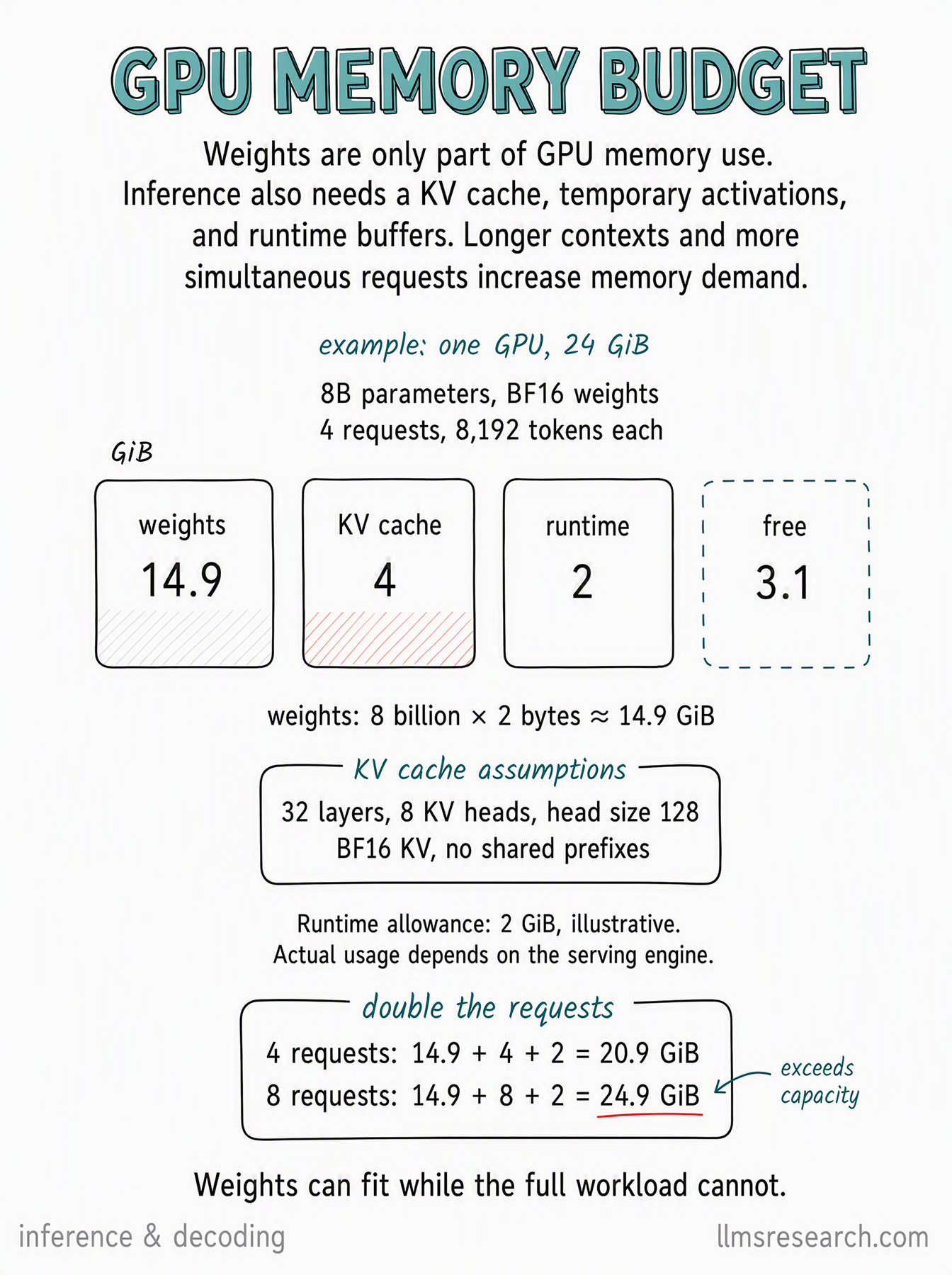
An LLM’s weight size is only one part of its GPU memory requirement. Inference also needs the key and value cache for active sequences, plus runtime buffers and temporary allocations. A model whose weights fit can still run out of memory when requests arrive.
A worked 24 GiB example
Eight billion BF16 parameters take about 14.9 GiB at two bytes per parameter. For a standard full-attention decoder, estimate the KV cache as:
2 × layers × KV heads × head dimension × bytes per value
  × cached tokens per request × concurrent requests
The leading two counts keys and values. With 32 layers, eight KV heads, a head dimension of 128, two-byte cache values, 8,192 tokens per request and four concurrent requests, the cache takes 4 GiB. Add an illustrative 2 GiB for runtime overhead: the total is about 20.9 GiB, leaving 3.1 GiB on a 24 GiB GPU.
Concurrency changes the answer
At eight concurrent requests, the same cache becomes 8 GiB. The total rises to about 24.9 GiB, exceeding the device capacity. Shorter contexts, fewer simultaneous requests or a smaller cache representation can change that calculation.
This is a capacity estimate, not a promise that a particular model will fit. Serving engines reserve memory differently, and architectures with sliding windows, compressed caches or shared prefixes need a different cache calculation. Measure peak memory with the intended workload.