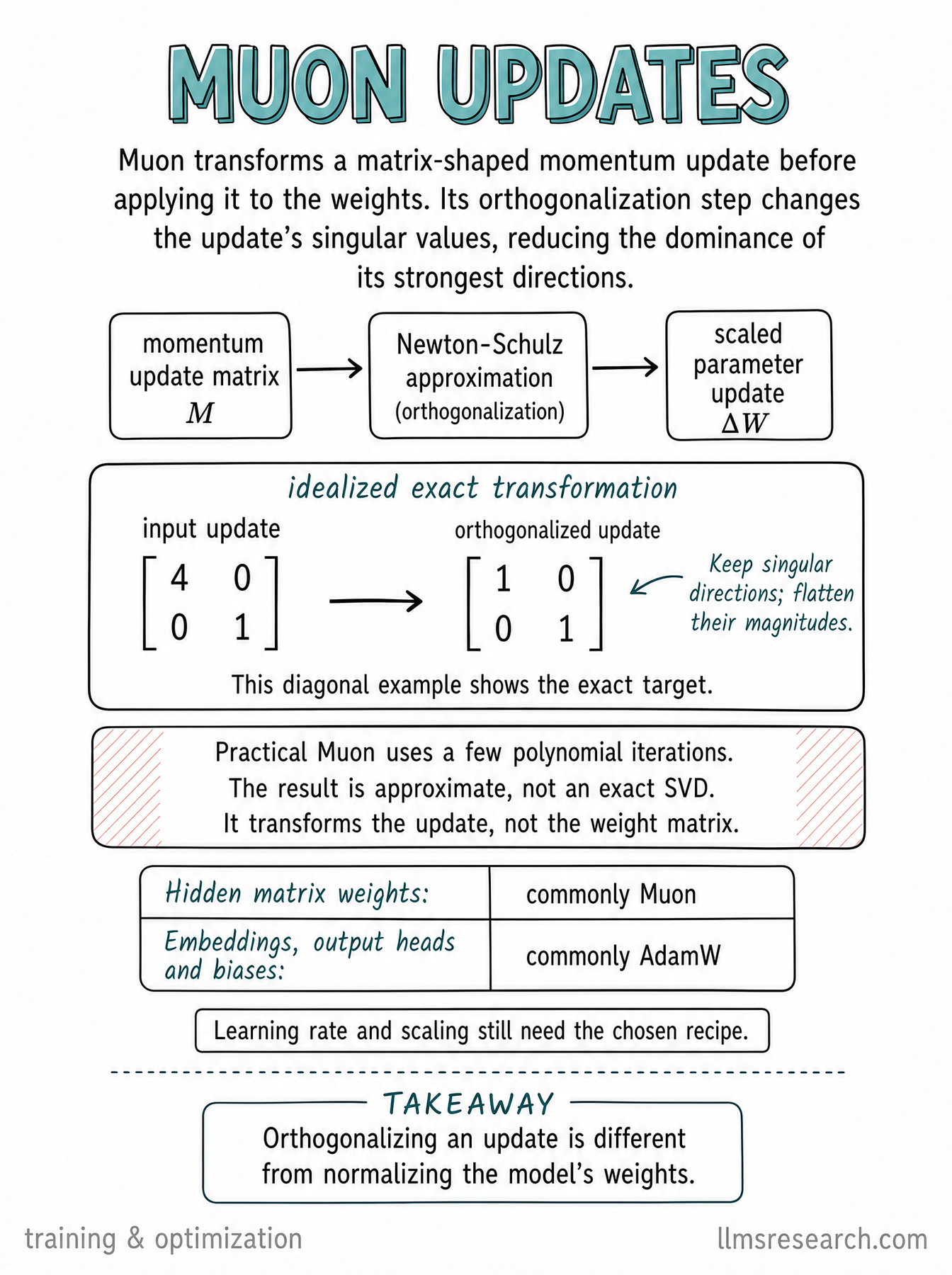
Muon transforms a matrix-shaped momentum update before applying it to the model. Its defining operation approximately orthogonalizes that update, changing how its singular directions are scaled.
Transform the update matrix
For an idealized singular value decomposition M = U S V^T, the corresponding orthogonalized update is U V^T. The card’s diagonal example starts with singular values 4 and 1. The ideal operation replaces both nonzero singular values with 1, so the larger direction no longer dominates in the same way.
The operation applies to the update. It does not require the model’s weight matrix itself to become orthogonal. That distinction prevents a common misunderstanding of what the optimizer constrains.
Approximation and parameter groups
Practical Muon implementations use a small number of Newton-Schulz-style iterations instead of computing an exact SVD on every step. Finite iterations are an approximation, and practical recipes also include scaling and other optimizer choices.
Muon is commonly applied to hidden-layer weight matrices. Biases, embeddings and other parameter groups may use a different optimizer such as AdamW. Compare the complete training recipe, rather than assuming one orthogonalization step defines every parameter update or guarantees a better result.