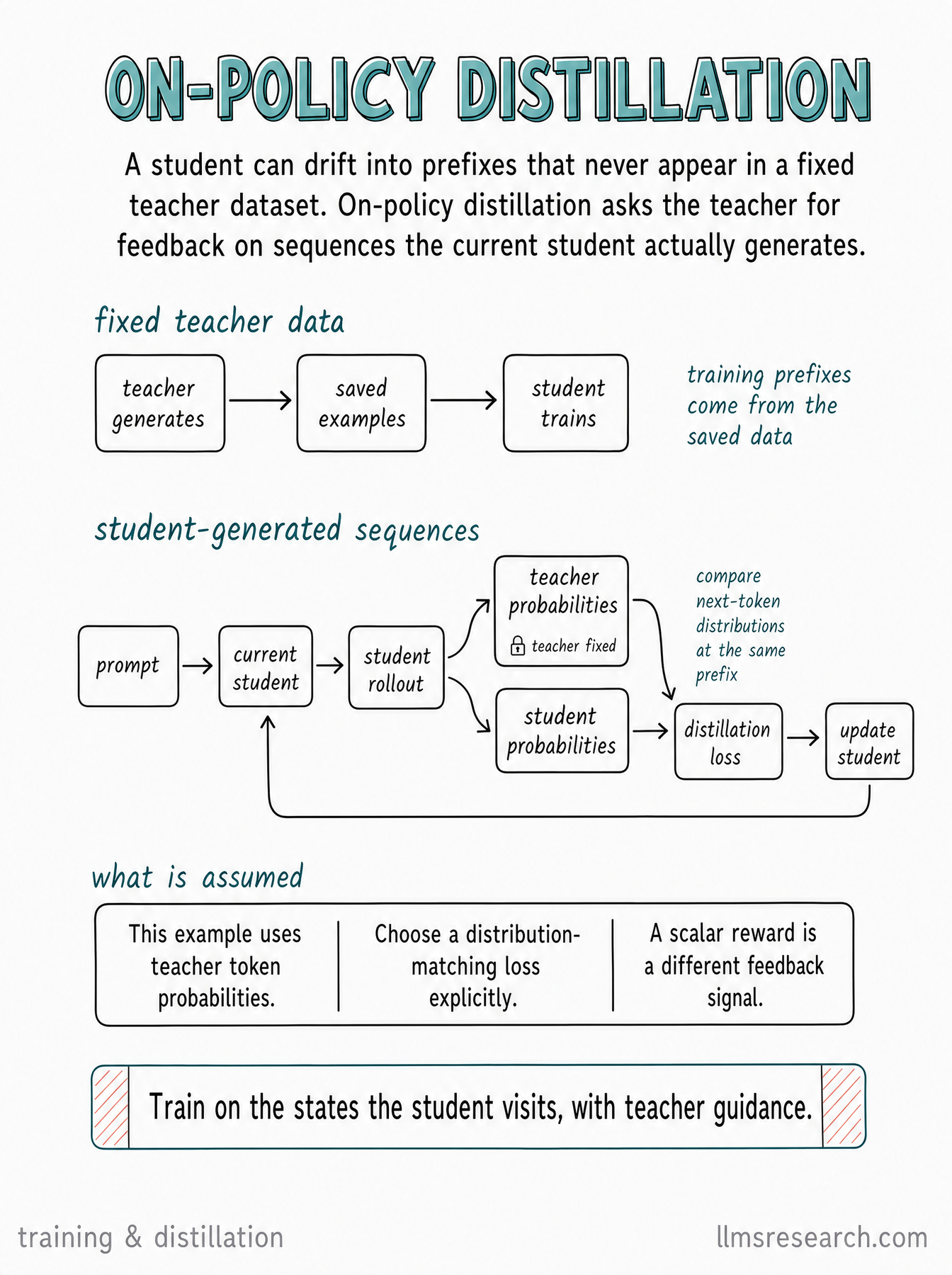
On-policy distillation trains a student using sequences the current student generates. The teacher provides feedback on those sequences, including prefixes the student would encounter when producing answers on its own.
Why the generated prefix matters
With a fixed teacher dataset, the student mostly trains on the teacher’s continuations. At inference time, one different student token can lead to a prefix that was never in that dataset. The next prediction must then be made from a different state.
In the card’s loop, the student samples a continuation. The teacher evaluates the same prefix, and a distillation loss encourages the student to match the teacher’s guidance there. Training updates the student, then later rollouts reflect its changed behavior. The teacher remains fixed in this example.
The tradeoff
The training data follows the student’s current behavior, but teacher evaluation and fresh generation add cost. Implementations differ in their divergence objective, feedback representation and mixture of on-policy and fixed data.
Do not confuse this with ordinary supervised training on saved teacher answers. The defining feature here is who generated the states being trained on: the current student.