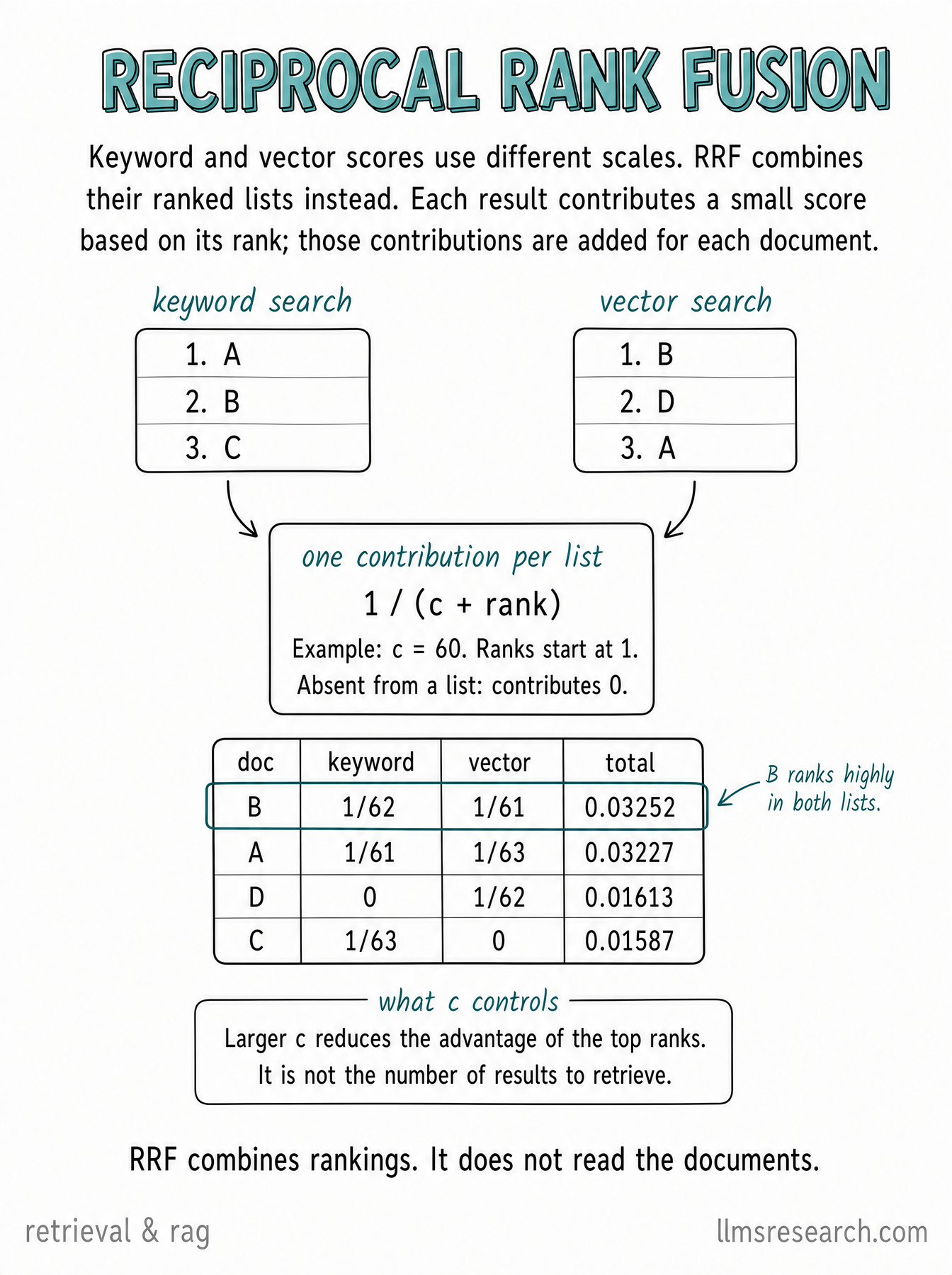
Reciprocal Rank Fusion combines ranked search results without comparing their raw scores. A keyword retriever and a vector retriever can use unrelated score scales. RRF uses each document’s position in each list instead.
Calculate one contribution per list
A document at rank r contributes 1 / (c + r). Ranks start at one. Add its contributions across the lists; a document absent from a list contributes zero.
In the card, keyword search returns A, B, C. Vector search returns B, D, A. With c = 60, B receives 1/62 + 1/61, about 0.03252. A receives 1/61 + 1/63, about 0.03227. B therefore finishes slightly ahead of A. D and C each receive only one contribution.
What RRF does not measure
RRF rewards strong positions across retrievers. It does not inspect document text or establish whether a passage answers the question. The rank constant and the number of candidates retained affect the result. Evaluate the fused list against labeled queries, and consider a separate reranker when the final ordering needs a closer relevance judgment.