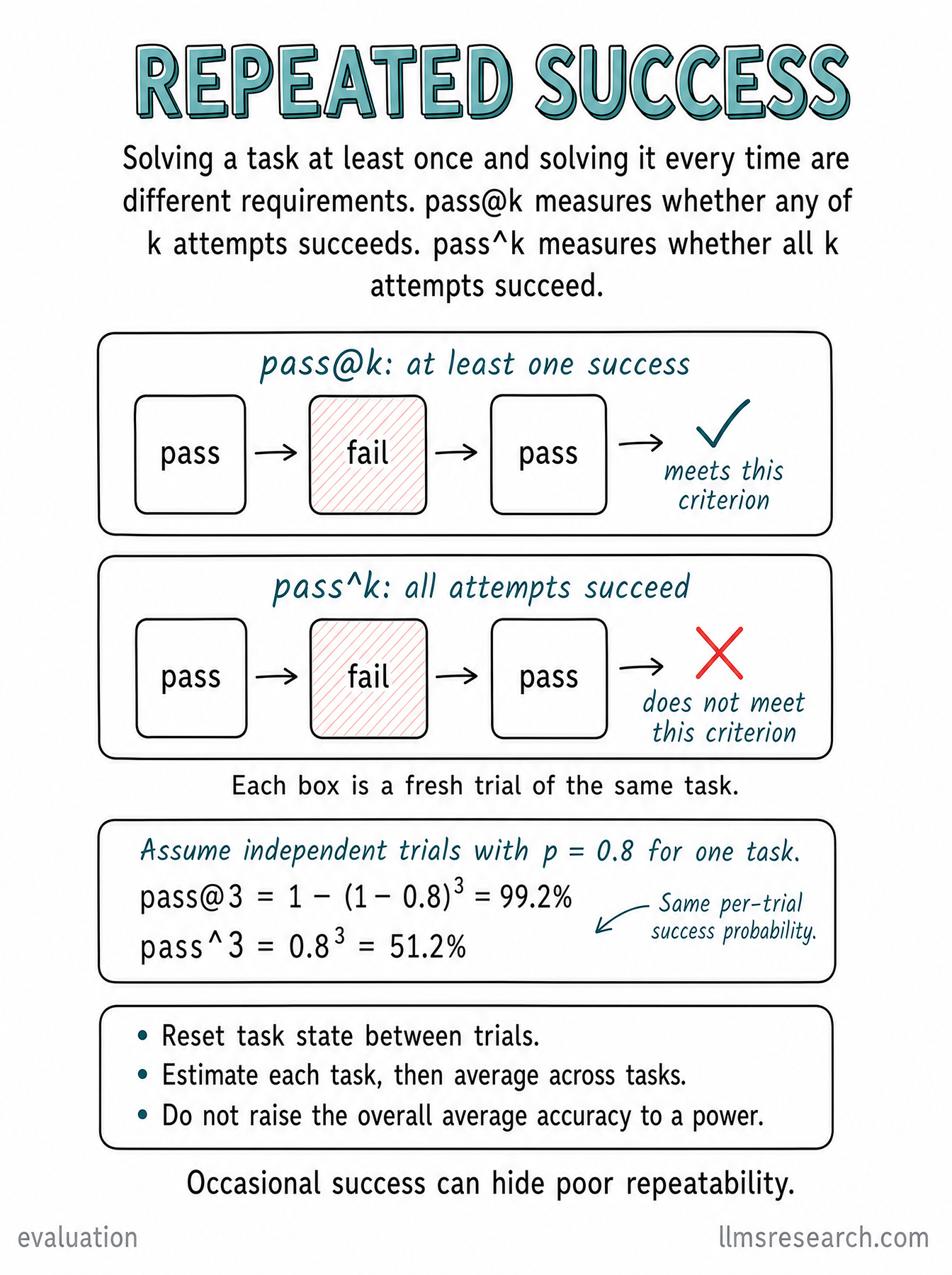
pass@k and pass^k ask different questions about repeated attempts. pass@k asks whether at least one of k attempts succeeds. pass^k asks whether all k attempts succeed. The first measures a chance to find a solution; the second measures repeatability.
One task, three independent attempts
For an illustrative task where every independent attempt has success probability 0.8:
pass@3 = 1 - (1 - 0.8)^3 = 0.992
pass^3 = 0.8^3 = 0.512
At least one success is very likely, while getting three successes is much less likely. The attempts are fresh runs of the same task, not three steps within one agent run.
Report the experiment, not just the label
The formulas above assume independent attempts and a fixed success probability for this one task. Measured benchmarks may estimate their metrics from finite samples. Task difficulty also varies, so compute the appropriate per-task quantity before aggregating; raising one pooled success rate to a power can give a different answer.
For pass@k to describe a useful workflow, the system also needs a way to identify a successful candidate. Producing one correct answer somewhere among several attempts does not mean the user can reliably select it.