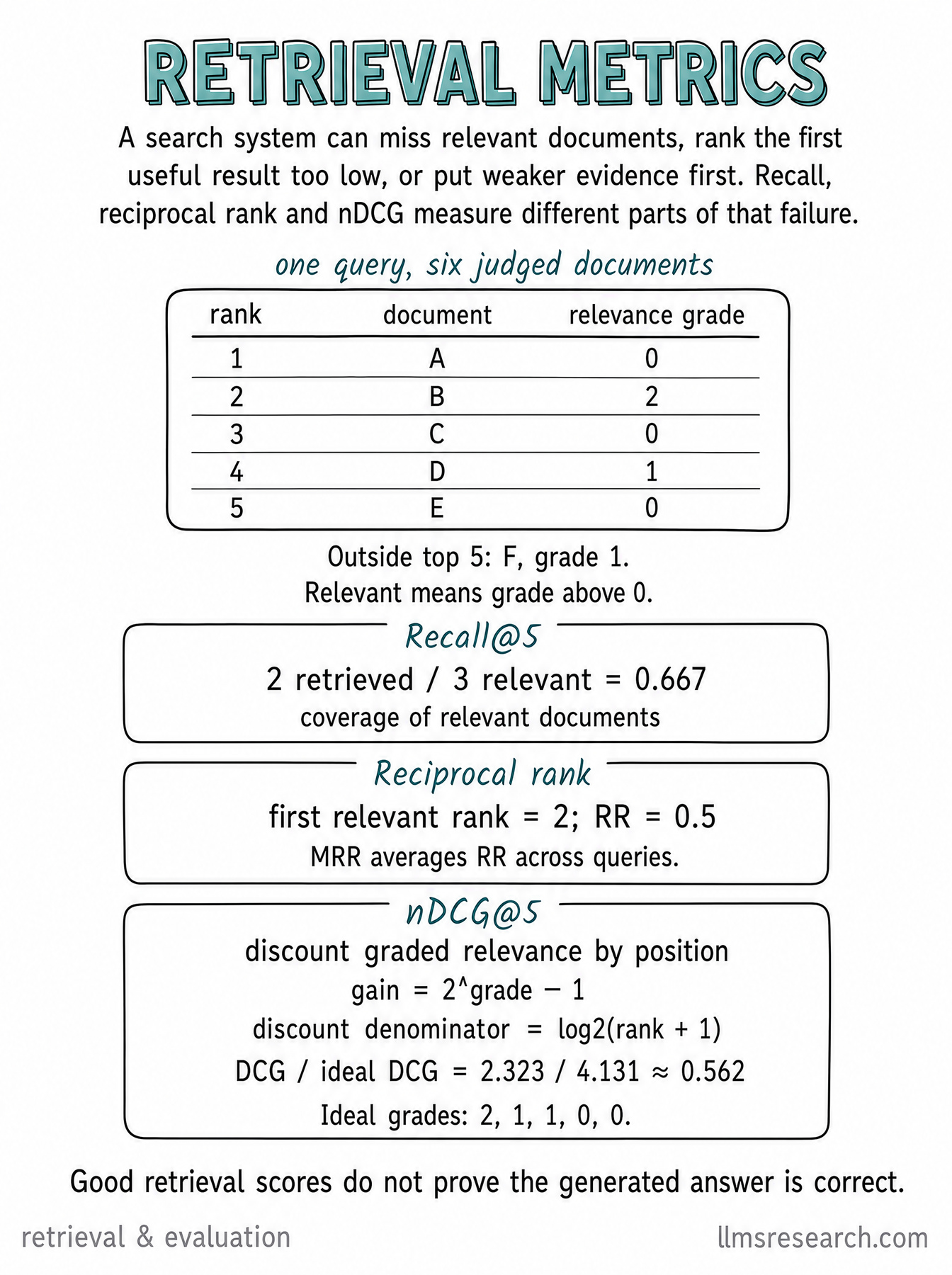
Recall@k, reciprocal rank and nDCG measure different properties of a search result list. A ranking can retrieve useful documents yet place the best ones too low, so one metric rarely explains every failure.
Work through one ranking
The first five documents in the example have relevance grades 0, 2, 0, 1 and 0. Another relevant document, graded 1, is outside the first five. Treating every positive grade as relevant, Recall@5 is therefore 2/3: two of the three relevant documents were retrieved.
The first relevant result is at rank two, so reciprocal rank is 1/2. MRR is the mean of reciprocal rank over multiple queries. One query’s value is reciprocal rank, not a separate average.
nDCG also uses relevance strength
Using gain 2^grade - 1 and discount log2(rank + 1), DCG@5 is about 2.323. The ideal ranking places grades 2, 1 and 1 first, giving about 4.131. Their ratio is nDCG@5, about 0.562.
State the relevance labels, cutoff and gain convention when reporting results. Recall needs a defined set of relevant documents; incomplete judgments can hide missing results. These metrics score retrieval, not whether the final generated answer is correct.